About Farmers
Farmer
(Redirected from Farmers)
For other uses, see Farmer (disambiguation)and Grower (disambiguation).
For the unincorporated community in Indiana, seeFarmers, Indiana.

A farmer[1] (also called an agriculturer) is a person engaged in agriculture, raising living organisms for food or raw materials. The term usually applies to people who do some combination of raising field crops, orchards,vineyards, poultry, or other livestock. A farmer might own the farmed land or might work as a labourer on land owned by others, but in advanced economies, a farmer is usually afarm owner, while employees of the farm are known as farm workers, or farmhands. However, in the not so distant past a farmer was a person who promotes or improves the growth of (a plant, crop, etc.) by labor and attention, land or crops or raises animals (as livestock or fish).
History
Farming has been dated back as far as theNeolithic era. By the Bronze Age, theSumerians had an agriculture specialized labour force by 5000–4000 BCE, and heavily depended on irrigation to grow crops. They relied on three-person teams when harvesting in the spring.[2] The Ancient Egypt farmers farmed and relied and irrigated their water from the Nile.[3]
Animal husbandry, the practice of rearing animals specifically for farming purposes, has existed for thousands of years. Dogs were domesticated in East Asia about 15,000 years ago. Goats and sheep were domesticated around 8000 BCE in Asia. Swine or pigs were domesticated by 7000 BCE in the Middle Eastand China. The earliest evidence of horsedomestication dates to around 4000 BCE.[4]
Advancements in technology

A combine harvester on an English farm
In the U.S. of the 1930s, one farmer fed only himself and three other consumers. The same farmer now feeds well over a hundred people. However, some authors consider this estimate as flawed as it does not take into account that farming requires energy and many other resources which have to be provided by additional workers, so that the ratio of people fed to farmers is actually smaller than 100 to 1.[5]
Types
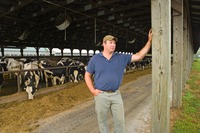
An American dairy farmer
More distinct terms are commonly used to denote farmers who raise specificdomesticated animals. For example, those who raise grazing livestock, such as cattle,sheep, goats, and horses, are known asranchers (U.S.), graziers (Australia & U.K.), or simply stockmen. Sheep, goat, and cattle farmers might also be referred to respectively as shepherds, goatherds, and cowherds. The term dairy farmer is applied to those engaged primarily in milk production, whether from cattle, goats, sheep, or other milk producing animals. A poultry farmer is one who concentrates on raising chickens, turkeys,ducks, or geese, for either meat, egg, orfeather production, or commonly, all three. A person who raises a variety of vegetables for market may be called a truck farmer or market gardener. Dirt farmer is an American colloquial term for a practical farmer, or one who farms his own land.[6]
In developed nations, a farmer (as a profession) is usually defined as someone with an ownership interest in crops or livestock, and who provides land or management in their production. Those who provide only labor are most often calledfarmhands. Alternatively, growers who manage farmland for an absentee landowner, sharing the harvest (or its profits) are known as sharecroppers or sharefarmers. In the context of agribusiness, a farmer is defined broadly, and thus many individuals not necessarily engaged in full-time farming can nonetheless legally qualify under agricultural policy for various subsidies, incentives, andtax deductions.
Techniques

A Nepali farmer
In the context of developing nations or other pre-industrial cultures, most farmers practice a meager subsistence agriculture—a simpleorganic farming system employing crop rotation, seed saving, slash and burn, or other techniques to maximize efficiency while meeting the needs of the household or community. Historically, one subsisting in this way may have been known as a peasant.
In developed nations, however, a person using such techniques on small patches of land might be called a gardener and be considered a hobbyist. Alternatively, one might be driven into such practices by poverty or, ironically—against the background of large-scale agribusiness—might become an organic farmer growing for discerning consumers in the local food market.
Farming organizations
Farmers are often members of local, regional, or national farmers' unions or agricultural producers' organizations and can exert significant political influence. The Grangemovement in the United States was effective in advancing farmers' agendas, especially against railroad and agribusiness interests early in the 20th century. The FNSEA is very politically active in France, especially pertaining to genetically modified food. Agricultural producers, both small and large, are represented globally by the International Federation of Agricultural Producers (IFAP), representing over 600 million farmers through 120 national farmers' unions in 79 countries.[7]
Income
Farmed products might be sold either to amarket, in a farmers' market, or directly from a farm. In a subsistence economy, farm products might to some extent be either consumed by the farmer's family or pooled by the community.
Occupational hazards
There are several occupational hazards for those in agriculture; farming is a particularly dangerous industry.[8] Farmers can encounter and be stung or bitten by dangerous insects and other arthropods, including scorpions, fire ants, bees, wasps, and hornets.[9] Farmers also work around heavy machinery which can kill or injure them.
See also
References
- Notes
- ^ Dyer 2007, p. 1: "The word 'farmer' was originally used to describe a tenant paying a leasehold rent (a farm), often for holding a lord's manorial demesne. The use of the word was eventually extended to mean any tenant or owner of a large holding, though whenGregory King estimated that there were 150,000 farmers in the late seventeenth century he evidently defined them by their tenures, as freeholders were counted separately."
- ^ By the sweat of thy brow: Work in the Western world, Melvin Kranzberg, Joseph Gies, Putnam, 1975
- ^ Nicholson (2000) p. 514
- ^ "Breeds of Livestock - Oklahoma State University". Ansi.okstate.edu. Retrieved2011-12-10.
- ^ Kirschenmann 2000.
- ^ Oxford English Dictionary
- ^ About the International Federation of Agricultural Producers
- ^ "Agricultural Safety". NIOSH. December 15, 2014.
- ^ "Insects and Scorpions". NIOSH. February 24, 2012.
- Bibliography
- Dyer, Christopher (2007). "A suffolk farmer in the fifteenth century". Agricultural History Review 55 (1): 1–22. JSTOR 40276126.
- Kirschenmann, Frederick (2000). "How many farmers will we need?" (PDF). Leopold Letter 12 (4): 3–4.
 Media related to
 The dictionary definition of


��You are accepted as fb friend ��
ReplyDeleteIf You want to be An Agro Businessman then contact us or Leave Comments / Message here.
Mr. #DevDhawal is Working as Agro Business Planner ( #ABP) with Many INGOs, NGOs & GOs to Develop Farmers Farm in Asia.
Contact Information :
Fsc Rupandehi Office ��
SiddharthaNager-12, Bhairahawa
Mobile �� : 977-9857046702 / 9801346702
( You Can connect with IMO/Skype/Duo/Viber ..... etc by using ±977-9857046702 )
Email �� �� : devdhawal98702@gmail.com
Office �� �� : rupandehifsc@gmail.com
Website : DevDhawal.blogspot.com
https://m.facebook.com/DevDhawal9870
Nice information on here, I would like to share with you all my experience trying to get a loan to expand my Clothing Business here in Malaysia. It was really hard on my business going down due to my little short time illness then when I got heal I needed a fund to set it up again for me to begin so I came across Mr Benjamin a loan consultant officer at Le_Meridian Funding Service He asked me of my business project and I told him i already owned One and i just needed loan of 200,000.00 USD he gave me form to fill and I did also he asked me of my Valid ID in few days They did the transfer and my loan was granted. I really want to appreciate there effort also try to get this to anyone looking for business loan or other financial issues to Contact Le_Meridian Funding Service On Email: lfdsloans@lemeridianfds.com / lfdsloans@outlook.com He also available on WhatsApp Contact:+1-9893943740.
ReplyDelete